The Philosophical Developer — Chapter 39: When Enthusiasm Outruns Discipline
2026-07-30 · 6 min read
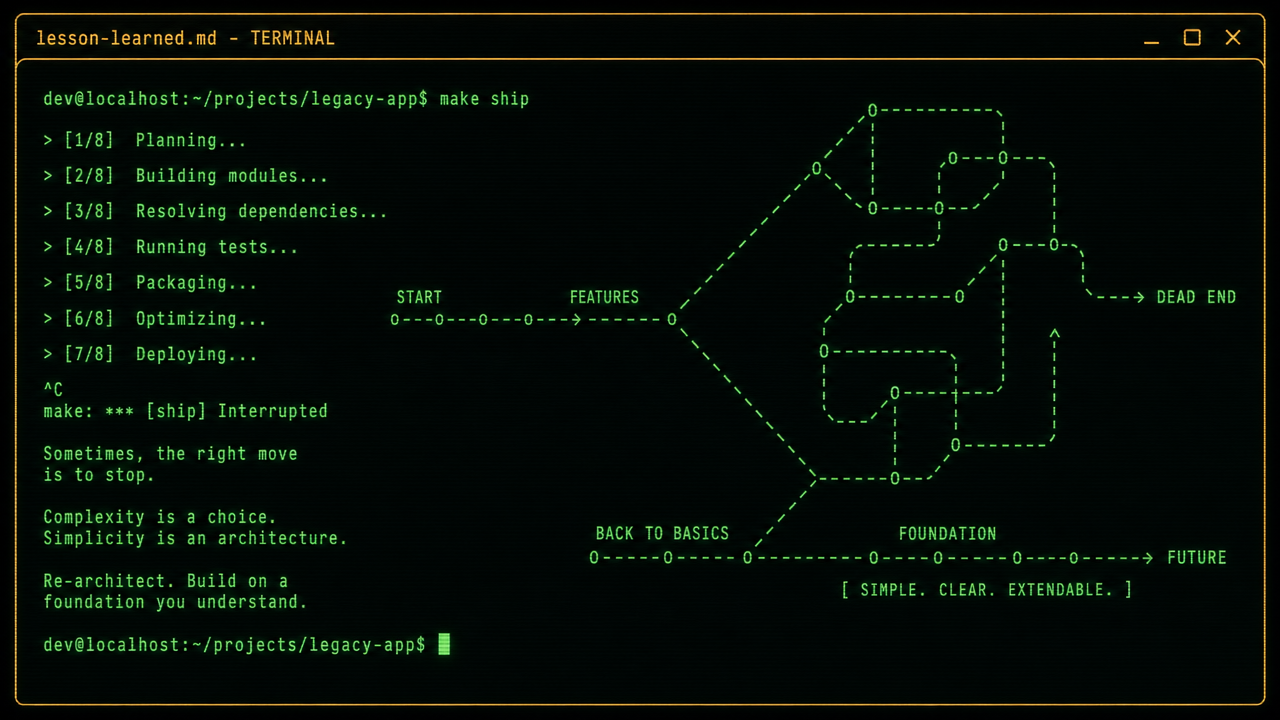
This is a different kind of chapter.
Chapters 37 and 38 described Spellcast — a dictation-first terminal multiplexer that I built with OrsonRius. Phase 1 was a working spike. Phase 2 added thirteen sub-phases: Tree-sitter tokenization, VAD, Vim navigation, multi-GPU, inline highlighting, prediction engine v2, explain v2, macros, emoticons, packaging, accessibility, and a plugin system.
The chapters made it sound like a finished product. It was not.
I am writing this chapter to close the loop. Not because the project is dead, but because I need to be honest about what happened, why it happened, and what I am doing differently next time.
What Spellcast actually was
Phase 1 worked. A PTY wrapper that captured audio, ran it through Whisper on the RTX 5090, tokenized the text, and injected it into a shell. You could speak, see your words tokenized, navigate between tokens, accept phonetic predictions, and commit text to the shell. It was a real, working prototype.
Phase 2 was a different story. I planned thirteen sub-phases and checked them all off in the plan. But “checked off” meant “the module compiles and has unit tests” — not “the feature is wired into the running application and works end-to-end.”
Here is what was not wired:
The explain feature (
ekey). Pressing it logs “explainer not yet wired.” The DB lookup, the LLM fallback, the web search — all written, all tested at the module level, none of it connected to the key that the user presses.Continuous VAD listening. The module exists. Silero VAD compiles, detects speech segments, and produces transcripts. The main loop still uses push-to-talk (Space key triggers a 3-second recording). The continuous listening code is in the repo but not the path the user takes.
The onboarding wizard. Eight steps written. Never called.
The plugin system. The trait, the manager, two built-in plugins. Not wired into the event loop. No CLI subcommands to manage them.
Several documentation files. Listed as complete in the plan. Not written.
The code is real. The tests pass. But the integration gap between a module and a feature is the difference between a prototype and a product. I skipped that gap.
How it happened
I got carried away.
The vision was compelling. Spellcast as the input layer for Chaossynergy — a system where speech is a first-class input channel, not a post-processed afterthought. I could see it working. I could describe it in detail. The architecture was sound. The modules were well-structured. The tests were green.
I confused architectural soundness with product readiness.
The numbers tell the story. Phase 1 shipped as a working MVP. Phase 2 tried to ship thirteen sub-phases in one cycle. Each sub-phase was individually reasonable, but together they were not one behavior per cycle — they were thirteen behaviors in one push. My own methodology says “one behavior per cycle” and “the slow approach is faster.” I broke both rules.
The enthusiasm was real. The vision was real. The discipline was not.
Why the methodology matters
The Philosophical Developer methodology exists for exactly this reason. Trace everything. One behavior per cycle. Red first, always. The slow approach is faster.
I designed these rules because I know myself. I get excited about big ideas. I see the whole system in my head and want to build it all at once. The rules are there to pull me back when my enthusiasm outruns my discipline.
I ignored them. The result was a lot of code that does not connect to itself.
The lesson is not that the methodology is wrong. The lesson is that the methodology only works when you follow it. Even — especially — when you are excited. The rules are not there for the boring days. They are there for the days when you want to build everything at once.
The code is not wasted
Every module in Spellcast taught me something. The Tree-sitter integration proved that AST-aware tokenization can distinguish prose from code with high accuracy. The VAD module proved that Silero can run in real-time on consumer hardware. The multi-GPU manager proved that an RTX 5090 and an RTX 4070 Ti can work simultaneously without contention.
The code is on GitHub. The tests pass. The architecture is documented. Anyone who wants to build a dictation tool can learn from it.
But I am not going to wire it up. Not now. Not in this form.
The new direction
Spellcast as a PTY wrapper was the right POC but the wrong architecture. The PTY wrapper intercepts input at the terminal level. That is useful for development and testing. But the real shape of this project is a daemon — a background process that owns the audio pipeline (capture, VAD, ASR, token stream) and exposes it over a Unix domain socket. The daemon is Phase 2D, the one sub-phase I deliberately did not start.
The new plan is to build the daemon first. The audio pipeline is the core. Everything else is a frontend. Terminal client, IBus IME engine, uinput injector — each is a separate cycle, a separate deliverable, a separate ship. The daemon gives them a stable foundation to connect to.
This is the slow approach. One behavior per cycle. Ship the daemon before you add the Vim navigation. Ship the terminal client before you add the emoticon macros. The methodology works when you commit to it.
What I want you to take from this
I am publishing this because transparency matters. Chapter 0 said that the work is real, the experiments are real, and the repos are on GitHub with trace tags. That is still true. But the writing has two voices, and only one of them is human. The chapters I did not write myself — the ones OrsonRius wrote — describe a system that was closer to finished than it actually was. That is my fault. I let the padawan describe the vision instead of the reality.
I am the architect. I am supposed to know when to say no. I said yes to thirteen sub-phases in one cycle. I will not do that again.
The repos are public. The code compiles. The tests pass. The modules are well-structured. But the integration is incomplete, and I am not pretending otherwise.
Spellcast is not dead. It is being re-architected. The daemon comes first. Everything else follows.
Repos:
This chapter is in my own voice. No padawan ghostwriting.